Do you have experience in cooking or gastronomy? I’d love your feedback.
What do you do when you’re following a recipe and realize you’re missing an ingredient? The food classification I propose in this article was born from exactly that problem.
If you cook regularly, you probably don’t think twice about it. You swap one vegetable for another, replace one legume with another, adapt the recipe to whatever you have in the fridge, or simply buy whatever looks freshest at the market and improvise from there. But not everyone cooks that way.
For many people, not having one specific ingredient is enough to give up on a recipe altogether. And if cooking already feels complicated, even a small obstacle can be enough to put them off.
One of the things I’m currently developing as part of The Food Clans is a food classification system. It started as a way to organize the game’s cards, but gradually evolved into something more interesting: a tool to help people think about ingredient substitutions and culinary uses.
It isn’t a game mechanic. Instead, it’s an extra feature that allows The Food Clans to become a creative tool in the kitchen: helping people explore alternatives, experiment with recipes and feel more confident adapting them.
A useful classification, not a perfect one
I’m not trying to create the definitive academic classification of foods, that would be impossible. Foods can be classified in many different ways: according to their botanical characteristics, nutritional properties, culinary uses…
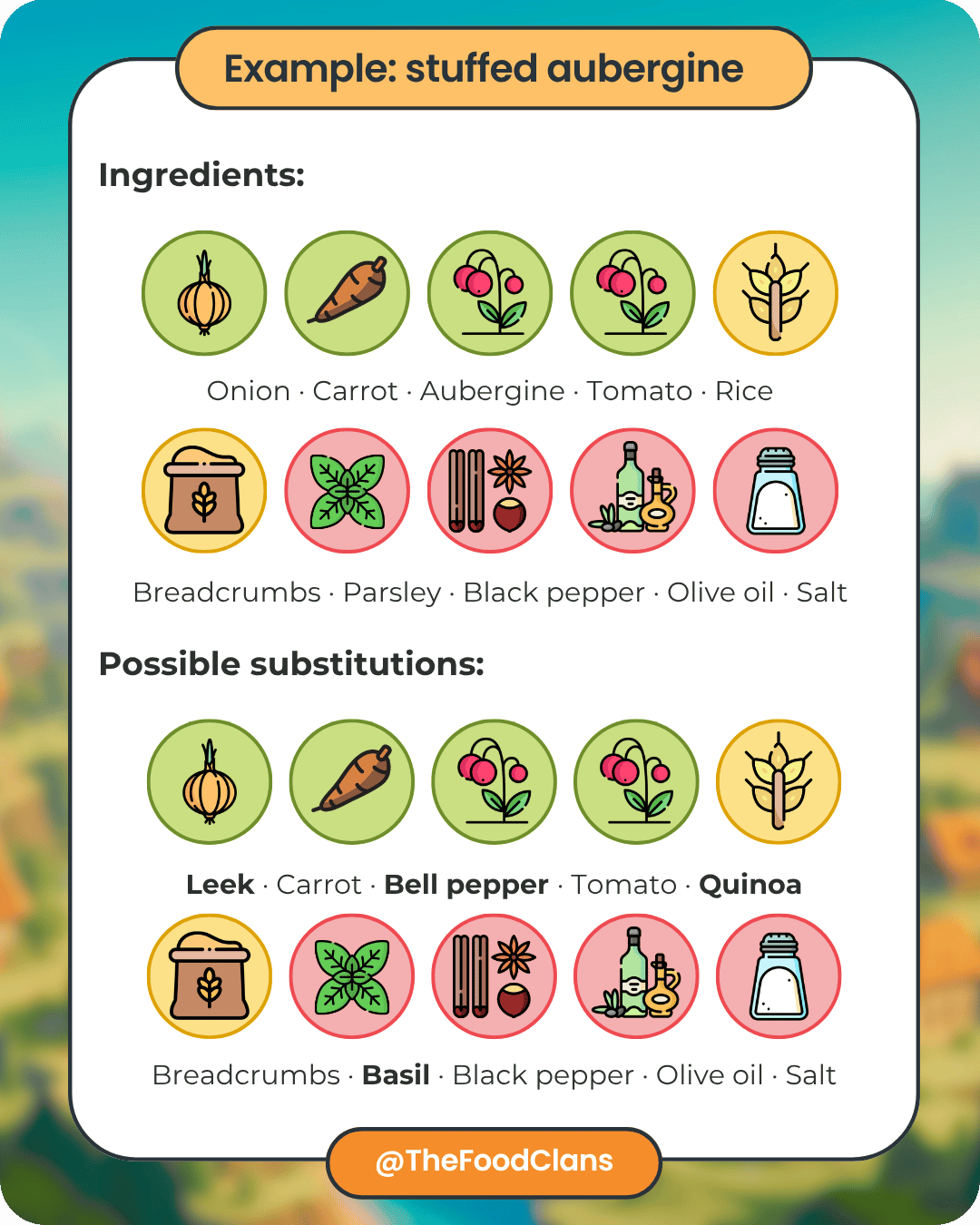
What I’m aiming for is something more practical: a classification that’s clear and flexible enough to inspire ideas and make substitutions easier. It won’t be perfect, and there will always be exceptions, but I still believe it can be useful. For example:
- If you were planning to make stuffed aubergines (eggplants), you could use the same filling in a courgette (zucchini), a bell pepper or a large tomato.
- If a dish calls for chickpeas, you could replace them with beans, lentils or dried peas.
- If a recipe uses cooked spinach, you could try Swiss chard, kale or even cooked lettuce.
- If a recipe uses walnuts to add texture, you could replace them with almonds, pistachios or chestnuts.
For experienced cooks these ideas may seem obvious, but for many people they aren’t. That’s where I think this system can help: by offering a starting point whenever uncertainty appears.
How I’m organizing this food classification
The main groups are the ones used in the game. Within each group I’ve created more specific subgroups. They aren’t part of the game’s mechanics, but they could help when looking for possible ingredient substitutions.
For vegetables, for example, I start with the part of the plant we eat: bulb, tuber, root, stem, leaf, fruit and flower. Mushrooms are included as a separate subgroup because of their culinary use.
Each of these plant parts has a different function (storing energy, providing structure, capturing light, protecting seeds…) and that may mean that, in some cases, different foods share similar textures, composition or culinary behaviour.
They won’t always be perfect substitutes, but they can offer a first clue when looking for alternatives.
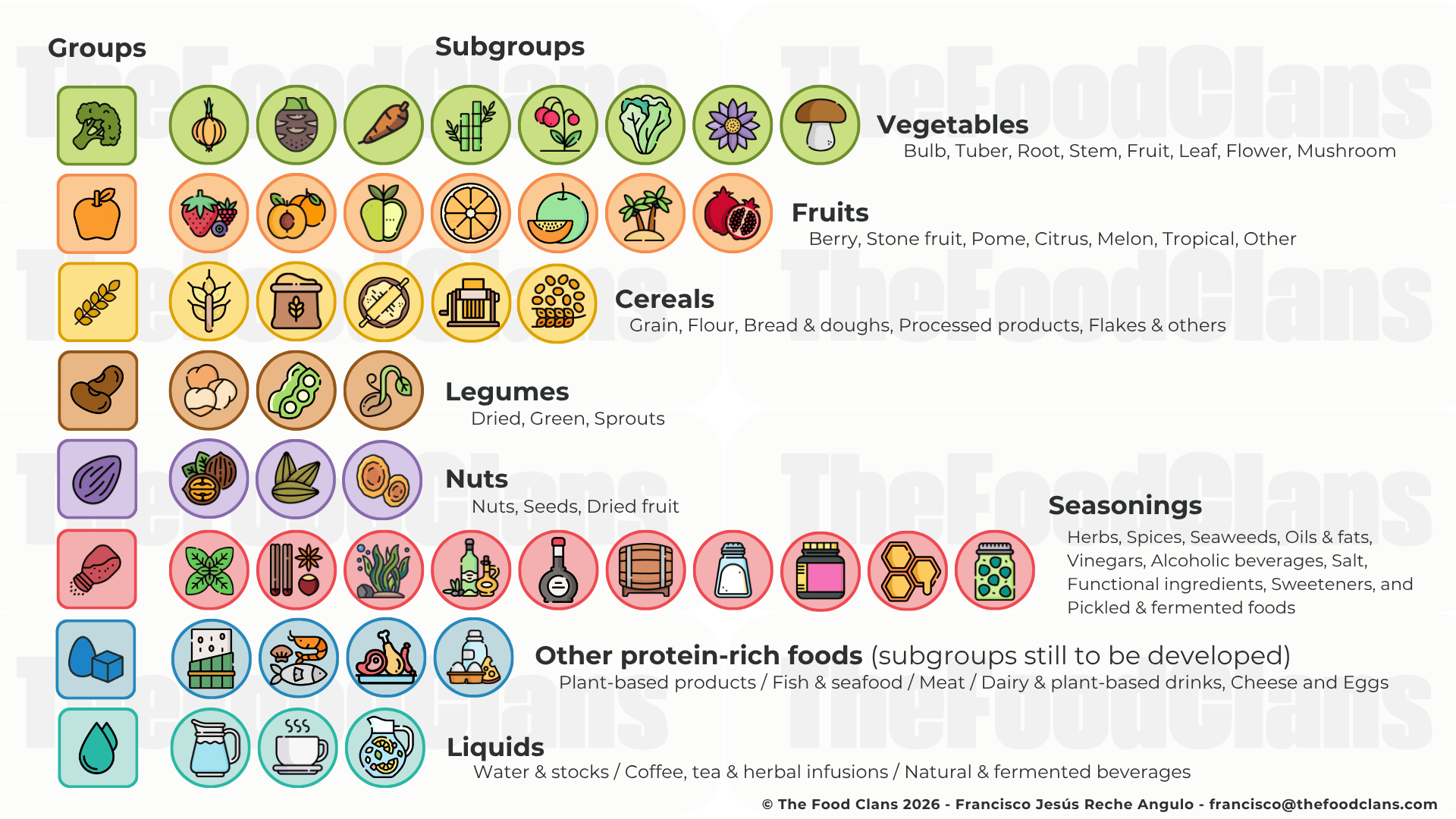
In the image you’ll find the current food groups and subgroups. Here are some of the questions I’d love your thoughts on:
- Would you change anything or regroup some foods differently?
- Would you organize the condiment subgroups in another way?
- Are there any foods that don’t seem to fit well?
The groups covering dairy products, eggs, plant-based proteins, fish and meat will be developed later, as they aren’t a priority for this first edition.
Would you like to review it in more detail?
You can download the working document with the complete classification, including all groups, subgroups and food examples.
➡️ The Food Clans – Food Classification (Working Draft – July 2026)
I’m especially interested in perspectives from other culinary traditions
Although I’ve tried to take a global approach, this system has inevitably been shaped by a Mediterranean culinary perspective. That’s why I’d especially love to hear from gastronomy professionals as well as people who cook within different culinary traditions and food cultures: Asia, Africa, Latin America, the Middle East, Eastern Europe… Perhaps there are important ingredients that don’t fit well into the current structure, or categories that make sense here but would be organized differently elsewhere.
The Food Clans is approaching production, so I’d like to use this opportunity to review the system one last time before everything is finalized. Any comments or suggestions would be hugely appreciated. You can contact me through social media, LinkedIn or by email at francisco@thefoodclans.com. My goal is to finalise the system during the first week of August, so I’d greatly appreciate any feedback or suggestions by 5 August.
It would also help a lot if you could share this post with anyone who might have an interesting perspective.
Thank you very much!